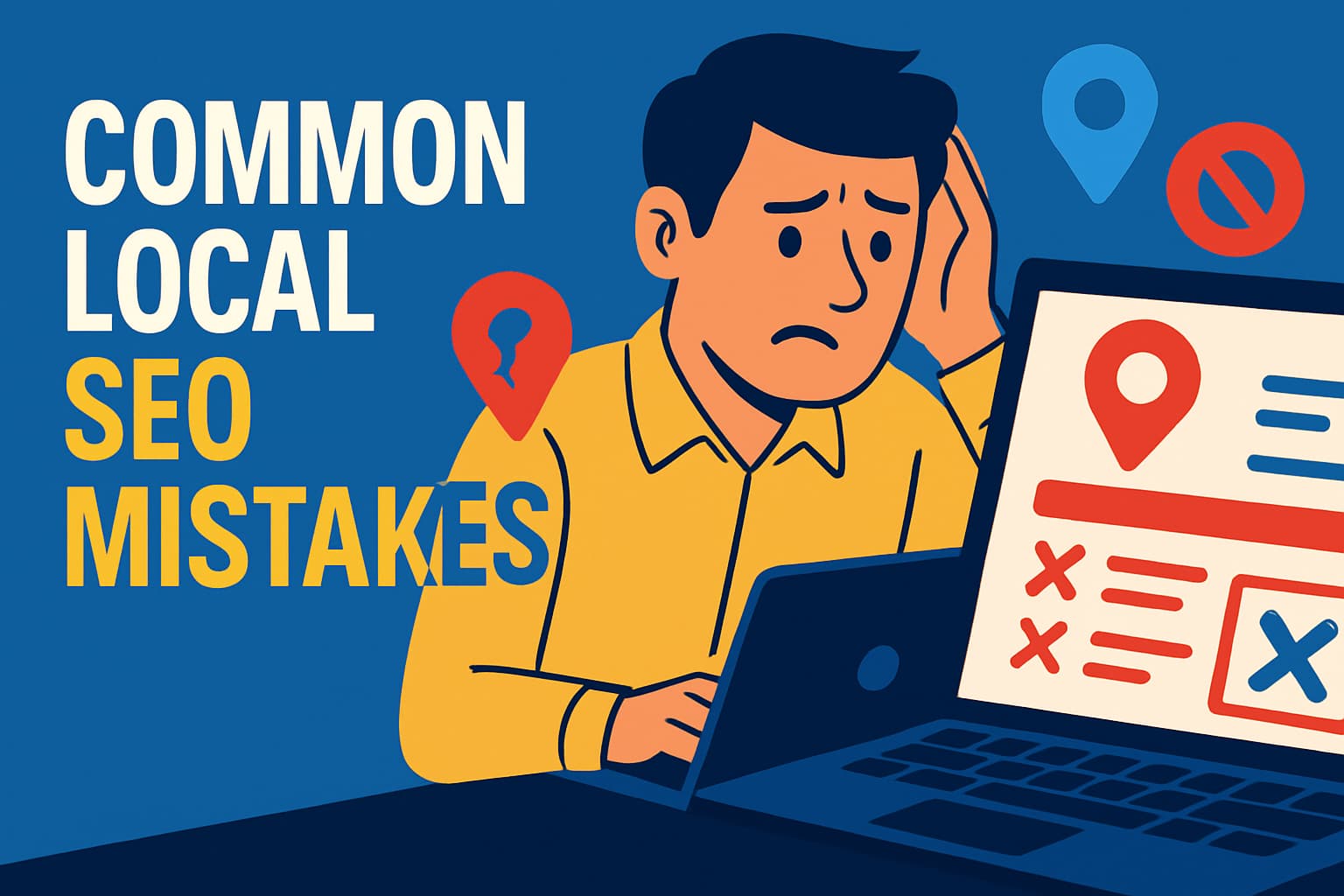
This article explores common local SEO mistakes UK SMEs make and how to fix them. Find out how to improve your appearance in search results.
Local SEO is no longer optional for small businesses and SMEs across the UK – it’s essential. Nearly half of all Google searches now involve local intent, meaning potential customers are actively looking for nearby products and services.
Whether someone is searching for a café in London or a plumber in Manchester, search engines like Google guide these decisions. Yet many small businesses continue making common SEO mistakes that reduce online visibility and lead to missed opportunities.
These mistakes are often unintentional, but they have a serious impact.
From outdated Google Business Profiles to poor mobile optimisation, small businesses risk losing visitors, lowering search rankings, and even creating a poor mobile experience that drives away customers.
In fact, the most common SEO mistakes can result in smaller companies struggling to compete with better-prepared competitors – despite offering great services.
Top SEO Mistakes Small Businesses Make
In this article, we’ll cover the SEO mistakes small businesses most often make, why these mistakes matter, and practical steps to fix them.

By avoiding the mistakes small businesses make and applying the right local SEO strategy, you’ll improve search visibility, attract more customers, and strengthen your digital marketing strategy.
Importantly, fixing SEO mistakes isn’t about chasing tricks – it’s about building a reliable foundation that ensures your business is found online, delivers a good user experience, and wins more customers over time.
Let’s dive into the most common local SEO mistakes – and the fixes that can make a big difference.
Neglecting Your Google Business Profile
The mistake:
One of the most common SEO mistakes small businesses make is failing to claim, verify, or regularly update their Google Business Profile (formerly Google My Business). Many business owners set it up once and then forget about it.
An incomplete profile, outdated information, or worse – not having one at all – creates missed opportunities and sends poor signals to search engines. This oversight is one of the biggest SEO mistakes small businesses fall into, often without realising.
Why it matters:
Your Google Business Profile is the first thing many local customers see when they perform local searches. It appears prominently in Google’s local search results and Maps.
If your listing is inaccurate, unverified, or inconsistent with other business listings, both search engines and potential customers may distrust your brand. Many small businesses underestimate how much weight Google gives this information.
A complete profile not only increases online visibility but also improves trust. Ignoring it means losing business to competitors who take it seriously.
How to fix it:
- Complete your profile fully: Enter your business name, address, phone number, website URL, hours, and service areas. Add accurate categories and detailed descriptions that reflect your services.
- Add quality images: Upload photos of your location, products, team, or even short videos. Profiles with images attract more clicks and boost engagement.
- Encourage reviews: Reviews are critical. Ask happy customers to leave reviews and respond promptly to both positive and negative ones.
- Keep it current: Any time you change address, phone number, or opening hours, update the profile immediately. Consistency prevents confusion and strengthens your credibility.
Actively managing your Google Business Profile ensures search engines understand your business and signals to potential customers that you are active, relevant, and trustworthy.
Inconsistent NAP Information Across the Web
The mistake:
Another of the most common SEO mistakes small businesses make is inconsistent NAP (Name, Address, Phone number) data across websites, directories, and listings.

A small variation in your business name or an outdated phone number can confuse both search engines and customers. These SEO mistakes are easy to overlook but can damage trust and lower your search rankings.
Why it matters:
Search engines rely on consistency to verify businesses. If your NAP details differ across sites, Google may question whether listings refer to the same business.
This uncertainty is one of the most common SEO mistakes that leads to losing visitors and lower conversion rates.
Customers might call the wrong phone number or arrive at an old address, leading to frustration and losing business. For small businesses already struggling with visibility, such errors create unnecessary barriers.
How to fix it:
- Audit your listings: Review your website, Google Business Profile, Yell.com, Facebook, Apple Maps, Bing Places, and other directories. Identify outdated or inconsistent details.
- Choose a single format: Standardise your business listing format (Street vs. St., Ltd. vs. Limited). Even small differences can confuse search engines.
- Use tools like: SEMrush, BrightLocal, or Moz Local to manage and monitor multiple directories. These SEO tools help update listings across platforms in bulk.
- Claim unverified listings: Take ownership of duplicate or third-party created listings. This gives you control to keep them accurate.
- Maintain long-term consistency: Revisit your NAP data after any business change. Many business owners forget this, which leads to common mistakes over time.
Consistency signals reliability. By avoiding these SEO mistakes small businesses make, you strengthen trust with search engines and ensure customers always have the right details to contact you.
Ignoring Local Keyword Optimisation
The mistake:
Many small businesses make the common SEO mistake of targeting only broad keywords and ignoring local search terms.
For example, optimising a website for “removals service” instead of “removals service in Birmingham” creates missed opportunities. This is one of the most common SEO mistakes because it prevents search engines from connecting your content with specific local intent.
Why it matters:
Local searches often include geographic modifiers like city names, postcodes, or “near me.” Without location signals, your website may fail to appear in valuable local results.
A solicitor in Leeds who doesn’t mention “Leeds” on their website pages will likely miss out on local customers, while competitors who optimise properly will rank higher.
Ignoring these signals is one of the biggest SEO mistakes small businesses make – it means losing visitors, losing business, and failing to connect with your target audience.
How to fix it:
- Do keyword research: Use tools like Google Keyword Planner, SEMrush, or autocomplete suggestions to find the right keywords for your targeting. Look for terms combining your services with your location.
- Optimise pages: Naturally include local search terms in title tags, meta descriptions, headings, and body text. Instead of keyword stuffing, focus on clarity and readability for your target audience.
- Create multiple pages for multiple locations: If you serve Manchester and Liverpool, create separate, unique pages with localised content rather than duplicating content across similar pages.
- Leverage Google Business categories: Ensure your Google Business Profile lists the right categories to capture local searches effectively.
- Include “near me” phrases naturally: Add wording like “serving local customers across [County]” to capture this search intent.
By incorporating local keyword optimisation into your SEO strategy, you prevent one of the most common SEO mistakes and help search engines understand your relevance.
This builds stronger search rankings, connects you with more customers, and ensures your business appears in the right local results.
Thin or Generic Website Content (No Local Focus)
The mistake:
One of the most common SEO mistakes small businesses make is publishing thin or generic content on their website. Many small businesses have only a handful of pages, or use vague wording such as “Welcome to our site, we offer services.”
Without detail, location, or relevant content, search engines struggle to understand what the website is about. This is an example of SEO mistakes small businesses repeatedly make, and it often leads to losing visitors, high bounce rates, and lower conversion rates.
Why it matters:
Content quality is a critical ranking factor. When your website lacks depth, search engines cannot connect it to the user’s query, and customers don’t trust you as an authority. If you fail to include location information, reviews, or useful detail, you’re essentially invisible to local customers.
Duplicate content across similar pages makes the problem worse, as Google’s algorithms may ignore or devalue those sections. Many business owners don’t realise that weak content means missed opportunities to attract more customers and convert visitors.
How to fix it:
- Build strong service pages: Each product or service deserves its own detailed page, with quality content that highlights benefits, process, and experience. For example, “Accounting Services in Bristol” should explain your expertise and include local customers’ testimonials.
- Incorporate local detail: Mention your location, community ties, or even case studies. This boosts relevance and helps search engines understand the context.
- Add NAP details: Place your business name, address, and phone number on every page, often in the footer, for consistency. This avoids one of the most common mistakes that harm local trust.
- Use schema / structured data: Implement LocalBusiness schema to give search engines clear signals.
- Avoid duplicate content: Don’t recycle generic content across multiple pages with only the city swapped. Each section should include relevant content tailored for that area.
Creating great content isn’t about stuffing keywords, it’s about providing valuable answers that engage your target audience. Fixing this mistake strengthens content marketing, improves search rankings, and prevents missed opportunities that cost you traffic and sales.
Missing Out on Local Citations and Directories
The mistake:
Another of the common SEO mistakes small businesses make is assuming that a website and a Google Business Profile are enough.

They ignore business listings and citations in directories like Yell, Noticed UK, Thomson Local, or industry-specific sites. This oversight is one of the most overlooked SEO mistakes small businesses make, costing them online visibility and more customers.
Why it matters:
Citations – consistent mentions of your business name, address, and phone – are a known ranking factor. When search engines see your business listing across multiple reputable sites, it confirms your legitimacy.
Missing out means missed opportunities, losing visitors, and allowing competitors to get ahead. Duplicate content or inconsistent listings can also hurt rankings. For many small businesses, ignoring citations is the difference between being found online and being invisible.
How to fix it:
- Submit to directories: Ensure your business is listed on Yell, Noticed UK, Yelp, Thomson Local, Bing Places, Apple Maps, and relevant industry platforms.
- Maintain consistency: Keep your NAP data the same across all listings. Even a different spelling in your business name is one of the common mistakes that lowers trust.
- Use tools: like BrightLocal, SEMrush, or Moz to automate checks. These SEO tools save time and help identify missing or duplicate listings.
- Claim duplicates: If your business listing appears twice, merge or delete extras to avoid confusing search engines.
- Track progress: Keep a list of your citations. Ongoing monitoring helps you avoid future SEO mistakes and keeps your SEO strategy strong.
By correcting this common SEO mistake, you increase website traffic, improve search rankings, and capture local customers searching across multiple directories.
Overlooking Local Link Building Opportunities
The mistake:
Many small businesses underestimate local link building. They don’t pursue backlinks from local partners, media, or organisations – one of the biggest mistakes small businesses make. These SEO mistakes limit growth and create ongoing missed opportunities to boost authority in the eyes of search engines.
Why it matters:
Links remain a strong ranking factor in Google’s algorithms. Local backlinks – from a Chamber of Commerce, community blogs, or local news sites – build trust and signal relevance. Without them, small businesses risk losing business to competitors. This is one of the most common SEO mistakes because owners assume backlinks are unnecessary. In reality, link building directly increases website traffic, conversions, and authority.
How to fix it:
- Network with local businesses: Partner with complementary services and exchange links on relevant pages.
- Sponsor events: Charities and clubs often publish links to sponsors. This provides both exposure and a valuable backlink.
- Write a blog post: Create locally relevant content (e.g., “10 Must-Visit Restaurants in Nottingham”) that others will link to. Blogging consistently supports your content strategy.
- Engage with local media: Share your expertise in articles or press releases. If a journalist adds a link to your website, it enhances authority.
- Join associations: Many associations include business listings with backlinks to your website.
Local backlinks help search engines understand your authority within a region. Avoiding this common SEO mistake strengthens your SEO efforts, drives more customers, and improves long-term website traffic.
Not Leveraging Online Reviews and Ratings
The mistake:
A major SEO mistake small businesses make is failing to collect and respond to online reviews. Many small businesses either feel awkward asking, don’t monitor feedback, or ignore negative reviews altogether.
This is one of the most common SEO mistakes that leads to losing business, losing visitors, and damaging your online reputation.

Why it matters:
Reviews are a powerful ranking factor in local SEO. Google considers the quality, frequency, and recency of reviews on your Google Business Profile when ranking search results. A business with fresh reviews will almost always outperform one with outdated or no feedback.
For mobile users who rely on quick search results, reviews often determine whether they call, visit, or keep scrolling. Unanswered negative reviews also create lower conversion rates, as potential customers lose trust.
How to fix it:
- Ask regularly: After delivering a service, politely request a review. Many business owners underestimate how many customers are willing to help if asked.
- Prioritise key platforms: Focus on Google first, but also consider Facebook, Yelp, TripAdvisor, or industry-specific review platforms.
- Make it easy: Share direct links to your review profiles via email, receipts, or your website. A short, clickable URL from Google makes a big difference.
- Respond to all reviews: Thank happy customers, and for critical ones, reply professionally. This prevents mistakes small businesses make when ignoring feedback. A respectful response to a negative comment often reassures other potential customers.
- Maintain consistency: A steady flow of reviews is better than a sudden spike. Consistent feedback signals to search engines that your business is active and trusted.
By avoiding this common SEO mistake, you increase online visibility, build trust with real people, and attract more customers. Reviews not only influence search rankings but also help convert visitors into loyal clients.
Poor Mobile Optimisation and Site Speed
The mistake:
A shocking number of small businesses still run outdated sites that provide a poor mobile experience. This includes non-responsive layouts, slow-loading pages, or buttons that don’t work properly on mobile devices.
It’s one of the most common SEO mistakes, and it causes losing visitors and lower conversion rates. For many small businesses, this is the single factor holding back their SEO strategy.
Why it matters:
The majority of local searches now happen on mobile devices. If your website isn’t optimised, you’re essentially losing business to competitors. Google uses mobile first indexing, meaning it primarily crawls the mobile version of your entire website when deciding rankings.
A website that loads slowly or fails Google’s Mobile Friendly Test is unlikely to appear prominently in search results. Poor performance also leads to high bounce rates, as impatient mobile users leave quickly. In short, ignoring mobile optimisation is one of the worst SEO mistakes small businesses make.
How to fix it:
- Use responsive website design: A responsive design ensures your website adapts across mobile devices, tablets, and desktops. This prevents the common mistake of alienating mobile users.
- Test across devices: Don’t assume. Run checks on Android, iOS, and smaller screens. Verify that text, buttons, and links work smoothly.
- Optimise images and videos: Compress images and streamline videos to avoid slow load times. Tools like Pagespeed Insights will highlight problem areas.
- Run Google’s Mobile Friendly Test: This free test identifies issues and offers specific fix suggestions. Pair it with Google Analytics and Google Search Console for full performance monitoring.
- Simplify design: Keep crucial information – phone number, address, contact buttons – easy to find. Avoid heavy pop-ups or clunky formatting that frustrates users.
- Invest in hosting: A good server improves speed dramatically. Many small businesses overlook this, but poor hosting often results in loads slowly errors.
By prioritising mobile optimisation, you avoid critical SEO mistakes, improve website traffic, and keep potential customers engaged.
A mobile friendly, fast website is no longer optional – it’s essential for more customers, better search rankings, and future-proof visibility in search engines.
Neglecting Social Media and Local Engagement
The mistake:
Many small businesses make the common SEO mistake of ignoring social media. Some set up profiles but stop posting, while others don’t even claim them.
This is one of the most common SEO mistakes, as social signals indirectly influence search engines, website traffic, and local trust. For many small businesses, overlooking social media means missed opportunities to attract more customers.
Why it matters:
Social media platforms often act like search engines themselves. Potential customers search for business listings on Facebook or browse local groups for recommendations. If your profile is outdated, inconsistent with your website, or inactive, it signals unreliability.
Worse, competitors that engage actively gain online visibility and establish trust. While likes and shares are not a direct ranking factor, they boost branded search results and send users to your website, reducing the risk of losing business.
How to fix it:
- Choose the right platforms: Identify where your target audience spends time – Facebook, Instagram, LinkedIn, or even smaller platforms like Nextdoor.
- Keep NAP consistent: Ensure your social profiles match your Google Business Profile, including address, phone number, and website URL. Inconsistency is one of the mistakes small businesses make.
- Post regularly: Share blog posts, promotions, videos, testimonials, and updates. Frequent posting prevents the common mistake of looking inactive.
- Engage with local customers: Respond quickly to comments, messages, and reviews. This provides a good user experience and builds authority.
- Use local hashtags and location tags: Adding your location helps capture local searches and improve online visibility.
By avoiding this SEO mistake, small businesses can strengthen their digital marketing strategy, attract more people, and convert visitors into paying clients.
Active social profiles complement your content marketing and prevent missed opportunities that competitors will happily capture.
Not Tracking and Analysing Your Local SEO Performance
The mistake:
One of the most overlooked SEO mistakes small businesses make is failing to track results. Many owners invest in a website, blogging, or social media but don’t use analytics to measure what works. This is one of the most common SEO mistakes because it leaves you blind to what brings website traffic, conversions, and sales.
Why it matters:
Without monitoring, you don’t know whether your SEO strategy is paying off. Search engines constantly evolve with algorithm updates, so relying on guesswork is risky.
A lack of analytics means you could continue with tactics that hurt rather than help. For example, publishing a blog post without tracking its traffic may result in missed opportunities if it performs poorly.
Conversely, you might overlook that your Google Business Profile is your top lead source. Many business owners assume their SEO efforts are effective but, without data, they can’t improve.
How to fix it:
- Install Google Analytics: Track website traffic, users, conversions, and identify which pages perform best.
- Use Google Search Console: Monitor which keywords and search terms trigger impressions and clicks. This highlights wrong keywords you might be targeting and reveals missed opportunities.
- Check Google Business Profile insights: Learn how many calls, direction requests, and visits come from your business listing.
- Set conversion goals: Define what matters – calls, emails, form submissions – and track them. This prevents the common mistake of chasing vanity metrics instead of results.
- Use tools like: SEMrush, BrightLocal, or Moz for deeper audits. They highlight SEO mistakes, duplicate content, and competitor performance.
- Revisit regularly: Monthly reviews help you adapt to Google updates, industry trends, and shifting user behaviour.
By avoiding this common SEO mistake, you gain clarity and control. Monitoring with the right tools transforms your SEO strategy from guesswork into a data-driven process that helps you achieve consistent results, attract more customers, and increase website traffic.
Conclusion: Avoiding Common Local SEO Mistakes
Local SEO gives UK small businesses a powerful way to connect with local customers, drive website traffic, and win more customers – but only if it’s done correctly.
The reality is that many business owners repeat the same common SEO mistakes, from neglecting their Google Business Profile to failing at mobile optimisation or ignoring keyword research. These SEO mistakes small businesses make cost them rankings, visibility, and ultimately, sales.
The good news is that most of the most common SEO mistakes are fixable. By claiming and updating your business listing, ensuring NAP consistency, optimising for mobile devices, and publishing relevant content, you prevent missed opportunities and strengthen your SEO strategy.
Avoiding duplicate content, fixing wrong keywords, and maintaining internal links are also crucial steps.
Success doesn’t require advanced tricks – it comes from mastering the basics and applying them consistently.
Keep your details accurate, optimise pages for local search terms, collect genuine reviews, and deliver quality content through your content marketing.
Use Google Analytics, Google Search Console, and other tools to monitor performance. Doing so prevents mistakes small businesses make and ensures you can adapt to Google’s algorithms and future algorithm updates.
For many small businesses, these changes mean the difference between being invisible and being discovered. A fast, mobile friendly, locally-optimised website provides a good user experience that helps you attract and convert visitors.
Pair that with social engagement, ongoing blog posts, and a data-driven digital marketing strategy, and your business will be ready to capture more customers in your area.
Ultimately, avoiding common SEO mistakes isn’t just about rankings – it’s about ensuring potential customers can find and trust you. In today’s competitive environment, where search engines dominate how people choose, getting your local SEO right is essential to survive and grow.
Boost Your Local SEO Today
Don’t let your business get overlooked in local searches. Add your business to our trusted business directory and build high-quality citations that strengthen your local SEO.
Trusted listings help search engines recognise your business, improve your online visibility, and connect you with more customers in your area.
Claim your spot now – add your business to our directory and start improving your local SEO today!
Sources:
Progress Digital (progressdigital.co.uk)
The Brains (thebrainsmarketing.co.uk)
Dalton Luka (daltonluka.com)
BrightLocal (brightlocal.com)
Econsultancy (econsultancy.com)
Yell Business (business.yell.com)